You're not behind.
You just haven't seen it done yet.
The Atrium is an Austin community for professionals who use AI tools and want to actually get better at them. Monthly events, a video library, a curated resource hub, and a forum where you can get unstuck. No lectures, no jargon, no pretending everyone is a developer. Just people in similar seats, figuring it out together.
Austin has AI communities. This one is built for the in-between.
Austin has AI communities. Most are built for engineers building AI products, or for people who still aren't sure what ChatGPT is. The Atrium is neither.
Eight reasons people keep coming back.
Answers to the questions you've been sitting on
The ones that feel too basic to ask at work, or too specific to find on YouTube. The Atrium is a room full of people with the same questions, and some with the answers.
Usage first, always
Every session is built around doing, not discussing. We build things live, walk through real workflows, and show how specific tools handle specific tasks. No theoretical overviews.
Best practices that actually travel
Not best practices for engineers. Best practices for the professionals in the room: lawyers, operators, marketers, finance people, chiefs of staff who need AI to fit the work they already do.
A place to share, not just absorb
Your workflow that saves two hours a week is worth more to someone in this room than anything a speaker could tell them. The Atrium is built to surface those exchanges, not suppress them.
Resources you'll actually use
A curated library of links, tools, and references kept current and organized by what you're trying to do. Not a list of everything that exists. A short list of what works. And a community forum for when you get stuck or need a second opinion on something specific.
People in the same seat as you
Mid-to-senior professionals across industries, all navigating the same transition. Not a developer networking event. Not a C-suite speaker series. A room of people building the skill together.
You give nothing to get something
It's free. No membership, no application, no sponsor pitch in exchange for your attention. Show up, learn something, leave with more than you brought.
A skill you can see yourself building
Not a crash course that ends. A monthly practice with sessions, videos, and a library of resources, designed to build fluency over time, not just awareness in an afternoon.
Why we don't charge for this.
The value of The Atrium comes from the room, not a registration fee. When people don't have to justify the cost of attending, they show up curious instead of expectant. That's the room we want to build. No tiered membership. No "premium content." No sponsors who get to pitch you in exchange for funding the food. The Atrium is free because the model works better that way.
- Free monthly in-person events. No RSVP fee, no waitlist cost.
- Short video library on the website, available at no cost any time
- Curated resource list and community forum. No form, no email gate.
- No advertising. No sponsor who paid to talk at you.
The work gets easier when the frame is visible.
We use plain diagrams in the room so people can talk about AI without getting stuck in tool names.
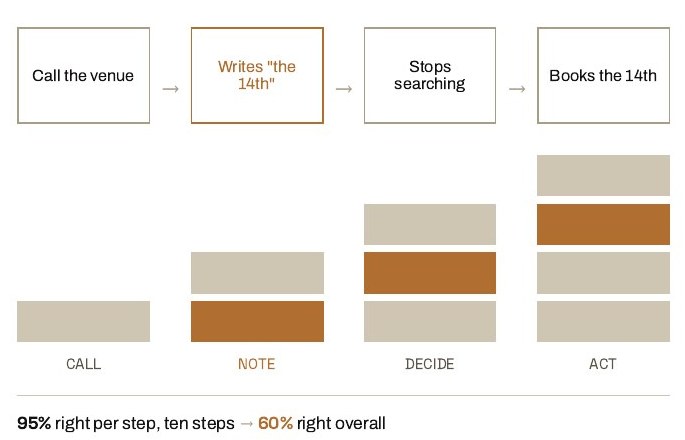
Less anxiety. More capability. No imposter syndrome.
The goal isn't to make you an AI expert. It's to make you someone who doesn't feel behind anymore.
You stop second-guessing whether you're using it right.
Seeing how other professionals in your field actually use AI (not how a YouTuber with 2M subscribers uses it) resets the standard. The bar is lower than the internet makes it look. And you're closer than you think.
You leave with something you can apply before the week is out.
Every session is designed around doing. The prompts, the workflows, the specific tool combinations are built to travel from the event to your actual job. Not concepts. Not frameworks. Techniques you can use on Tuesday.
AI stops feeling like it's moving faster than you can keep up.
Most of the anxiety about AI comes from trying to track everything at once. The Atrium filters that down: here's what matters, here's what you can ignore, here's what's actually worth your time. The noise gets quieter.
You already know what AI is. That's the entry point.
The Atrium isn't for people who need to be convinced that AI matters. It's for people who already know it matters and haven't figured out how to make it work in their specific job yet.
You know what Claude is. You know what ChatGPT is. You've maybe used one of them to draft something or answer a question. But you haven't crossed into daily use, and you're not sure where to start.
You're not behind. Most of what people call "using AI" is just prompting badly, faster.
These are the seats we designed the gatherings around.
HR director at a 200-person company
Knows AI can help with job descriptions and performance reviews. Hasn't found a workflow that doesn't produce garbage on the first try.
Chief of staff at an early-stage startup
Uses AI every day for some things. Has a mental list of 20 more things it could probably do. Never enough hours to figure out how.
Marketing manager at a mid-market company
Team keeps talking about AI. Has experimented. Hasn't cracked the workflow that actually replaces something on the to-do list.
Finance professional building toward a leadership role
Follows what's happening. Feels consistently behind. Wants to walk into a room where that feeling goes away.

I built this because I was tired of feeling like the only person in the room who still felt behind.
I've used AI every single day since ChatGPT launched. I read the newsletters, listen to the podcasts, sign up for every webinar I can find, build something new every few weeks just to keep the skills sharp. I've automated real chunks of my job. I've shipped tools I actually use.
And I still get that feeling. The one where a new model drops or a new capability gets announced and suddenly the ground shifts a little. The quiet, low-grade anxiety that you're somehow not keeping up, even when the evidence says otherwise.
I've sat in AI sessions where I was at or above the level of the speaker. I kept looking for the room where the conversation matched where I actually was. I stopped looking and built it instead.
What I noticed is that this feeling doesn't go away when you learn more. It goes away when you're around other people who feel it too. When someone across the table says "yes, that's exactly where I'm stuck," the imposter syndrome loses its grip. You realize the bar is lower than the internet makes it look, and you're further along than you thought.
The Atrium is the room I kept looking for. A place where mid-career professionals can drop the performance, ask the real questions, share what's actually working, and leave with something usable. No one here has it all figured out. That's the whole point.
No performances required. You don't have to know the latest model name or have a hot take on the state of AI. You just have to be genuinely curious and willing to share what you know.
Vulnerability is the point. The most useful conversations I've ever had about AI started with someone saying "I have no idea how to do this." That's not weakness. That's the beginning of actually learning something.
You give as much as you take. Somewhere in your head right now is a workflow, a prompt, a shortcut that saves you real time. Someone in this room needs exactly that. Bring it.
The next gathering is Wednesday, October 21.
Free. No pitch. No upsell. Just a room full of Austin professionals taking AI seriously.